The Russian invasion of Georgia, has brought back many of the ghosts of the Cold War. Some even think that recent events (US Missile Sites in Poland, Russia resuming strategic bomber flights, Russian invasion of Georgia, etc.) are a harbinger of a new Cold War. What do you guys think?
Here is a funny video that celebrates our Cold War heritage, sadly enough this is a real video. And I hope we will never have to teach/learn the nuke drill again.

Click image to begin the short survey. Thank You.
Friday, August 15, 2008
Saturday, August 9, 2008
Ossetian Conflict: Latest Developments
To read about the first 2 days in detail:
Day 1
Day 2
Update 08/12/08 10:14AM PT: Russia has supposedly suspended military operations. EU and Russia have worked out a 6-point peace plan, and conditions for the Georgian administration to meet before peace.
Update 08/11/08 9:56AM PT: Just as President Dmitri Medvedev has implied that major Russian military operations are coming to a close, Russia has opened up a second front in Abakhazia. Russian forces have captured Gori which is 35 miles from the Georgian capital. Russian diplomats have implied that regime change is their motive, and will not accept any deal without a regime change in Georgia.
Update 08/10/08 8:53AM PT: Georgian forces have completely withdrawn from Ossetia, and have supposedly been given cease-fire orders. Georgia hopes to bring Russia to the negotiating table. However, Russia is not confirming these reports and insists that fighting still continues.
Update 08/09/08 10:44PM PT: Russian planes have attacked airbases in Georgian capital. Obviously this is an act of war, and shows the Russian intent to widen their campaign. The next major escalation would be an official declaration of war from one of the sides.
Analysis 08/09/08 5:43PM PT: This had initially looked like a peacekeeping operation by the Russians, but it has turned out to be a much wider conflict than we had anticipated. I think this "invasion" was a very calculated step by Russia. The context of this incursion resembles the Israel-Lebanon war 2 years ago. Israel just didn't attack Hezbollah controlled regions, but all of Lebanon. The constant negative media coverage eventually turned the opinion against the conflict, and Israel withdrew. However, in Russia's case, the Olympics will detract from any media coverage of this conflict, thus giving them almost a free pass.
Day 1
Day 2
Update 08/12/08 10:14AM PT: Russia has supposedly suspended military operations. EU and Russia have worked out a 6-point peace plan, and conditions for the Georgian administration to meet before peace.
Update 08/11/08 9:56AM PT: Just as President Dmitri Medvedev has implied that major Russian military operations are coming to a close, Russia has opened up a second front in Abakhazia. Russian forces have captured Gori which is 35 miles from the Georgian capital. Russian diplomats have implied that regime change is their motive, and will not accept any deal without a regime change in Georgia.
Update 08/10/08 8:53AM PT: Georgian forces have completely withdrawn from Ossetia, and have supposedly been given cease-fire orders. Georgia hopes to bring Russia to the negotiating table. However, Russia is not confirming these reports and insists that fighting still continues.
Update 08/09/08 10:44PM PT: Russian planes have attacked airbases in Georgian capital. Obviously this is an act of war, and shows the Russian intent to widen their campaign. The next major escalation would be an official declaration of war from one of the sides.
Analysis 08/09/08 5:43PM PT: This had initially looked like a peacekeeping operation by the Russians, but it has turned out to be a much wider conflict than we had anticipated. I think this "invasion" was a very calculated step by Russia. The context of this incursion resembles the Israel-Lebanon war 2 years ago. Israel just didn't attack Hezbollah controlled regions, but all of Lebanon. The constant negative media coverage eventually turned the opinion against the conflict, and Israel withdrew. However, in Russia's case, the Olympics will detract from any media coverage of this conflict, thus giving them almost a free pass.

Friday, August 8, 2008
Russian Invasion of Georgia: Day 2
To read yesterday's developments and the beginning of hostilities click here
Update 5:41PM PT: Newest Developments are now here
Update 5:07PM PT: It is hard to ascertain what is going on right now, because there are so many conflicting reports. But I have pieced together what seems to be going on right now. A Russian Airborne Division and their 58th Army division have control over the Ossetian capital. Meanwhile, Su-25 close air support aircraft, and Tu-22("Backfire") bombers are hitting Georgian targets. I heard reports of ballistic missile strikes, but it seems they are likely just mis-characterized cruise missile strikes.
Update 4:53PM PT: How quickly things change! It seems that Moscow desires to take this conflict to a new level. CNN is reporting strategic bomber and ballistic missile attacks on Georgian cities. US diplomats are calling this escalation a "disproportionate" response. We have started voluntary evacuations of our embassy in the Georgian capital. This conflict seems to have taken a turn for the worst. Russians have significantly impaired Georgian civilian infrastructure, and I believe a formal declaration of war is imminent.
Update 12:18PM PT: An EU and US envoy has been sent to region to mediate the conflict. No reports of an expansion of the Russian front. There are some unconfirmed reports that Abhakaz volunteers and some local Russian militias are participating in this conflict. The only thing that is certain is that there are many different factions, and that will complicate any cease-fire agreement.
Update 9:07 AM PT: Georgian Officials are about to declare a "state of war", which is in essence a martial law declaration and not a declaration of war. The Georgians claim that they have downed 10 Russian aircraft, and Russia is the aggressor. Moscow firmly denies this and claims that they are still running peacekeeping operations. Civilian and Military fatalities combined are between 1,000 and 2,000. Some reports claim that the South Ossetian capital has been completely destroyed. The Russians are supposedly mobilizing their Black Sea fleet, but still there are no new reports of ground troops entering Georgian territory. Fighting seems to have been sporadic throughout the day, albeit peppered by intermittent air strikes by Russia. Much of the media coverage has focused on the Olympics, so we likely don't have a full picture of what is going on.
Initial Report: It is now morning in Georgia, and both sides are taking stock of their gains and losses. Fighting has escalated a bit, and what was once a concentrated conflict has spread to other Georgian cities. Russian warplanes have target civilian and command infrastructure in Georgia. Heavy causalities are reported on both sides due to the severe urban warfare in South Ossetia. Russian leaders have released increasingly belligerent statements and seem determined to vanquish Georgia. NATO diplomats are scrambling to create a cease-fire agreement between all the factions. As the day progresses we should learn more about the present state of affairs in Georgia, and we might learn of any further escalation of tensions. However, there is some good news: It doesn't appear that Russia has sent any more ground troops into the troubled region, and they are waging war in a way to minimize civilian casualities.
As Moscow wakes up we will really learn the reaction to the news, and that will give us some insight in to how long this conflict will last. If nationalist forces within the country prevail we could see a long term occupation of much of Georgia. If more moderate, pro-western forces prevail, we will see some sort of a deal in the next few days. For whatever it is worth, this conflict will not spill over Georgian borders. Some are claiming that this is the start of Russia's aggressive takeover of former Soviet states. Though I think these actions are completely unacceptable, and Russia should not be allowed to occupy these sovereign nations, I don't think this is the start of a larger assertion of power. Russia already has economic control of these countries; a physical military occupation is not necessary to prove that. What is yet to be seen is the reaction of other CIS states, and whether it is pro-Russia or pro-West. I would think most of the Baltic countries are pretty scared right now because Russia shown a motivation to protect their borders. Also this brings a serious question about NATO unity. If one of these Baltic allies are attacked are the original NATO members ready for an all-for-one response? Georgia was pushed as a possible NATO candidate, what happens if a fringe NATO ally is attacked?
To read yesterdays developments click here
Update 5:41PM PT: Newest Developments are now here
Update 5:07PM PT: It is hard to ascertain what is going on right now, because there are so many conflicting reports. But I have pieced together what seems to be going on right now. A Russian Airborne Division and their 58th Army division have control over the Ossetian capital. Meanwhile, Su-25 close air support aircraft, and Tu-22("Backfire") bombers are hitting Georgian targets. I heard reports of ballistic missile strikes, but it seems they are likely just mis-characterized cruise missile strikes.
Update 4:53PM PT: How quickly things change! It seems that Moscow desires to take this conflict to a new level. CNN is reporting strategic bomber and ballistic missile attacks on Georgian cities. US diplomats are calling this escalation a "disproportionate" response. We have started voluntary evacuations of our embassy in the Georgian capital. This conflict seems to have taken a turn for the worst. Russians have significantly impaired Georgian civilian infrastructure, and I believe a formal declaration of war is imminent.
Update 12:18PM PT: An EU and US envoy has been sent to region to mediate the conflict. No reports of an expansion of the Russian front. There are some unconfirmed reports that Abhakaz volunteers and some local Russian militias are participating in this conflict. The only thing that is certain is that there are many different factions, and that will complicate any cease-fire agreement.
Update 9:07 AM PT: Georgian Officials are about to declare a "state of war", which is in essence a martial law declaration and not a declaration of war. The Georgians claim that they have downed 10 Russian aircraft, and Russia is the aggressor. Moscow firmly denies this and claims that they are still running peacekeeping operations. Civilian and Military fatalities combined are between 1,000 and 2,000. Some reports claim that the South Ossetian capital has been completely destroyed. The Russians are supposedly mobilizing their Black Sea fleet, but still there are no new reports of ground troops entering Georgian territory. Fighting seems to have been sporadic throughout the day, albeit peppered by intermittent air strikes by Russia. Much of the media coverage has focused on the Olympics, so we likely don't have a full picture of what is going on.
Initial Report: It is now morning in Georgia, and both sides are taking stock of their gains and losses. Fighting has escalated a bit, and what was once a concentrated conflict has spread to other Georgian cities. Russian warplanes have target civilian and command infrastructure in Georgia. Heavy causalities are reported on both sides due to the severe urban warfare in South Ossetia. Russian leaders have released increasingly belligerent statements and seem determined to vanquish Georgia. NATO diplomats are scrambling to create a cease-fire agreement between all the factions. As the day progresses we should learn more about the present state of affairs in Georgia, and we might learn of any further escalation of tensions. However, there is some good news: It doesn't appear that Russia has sent any more ground troops into the troubled region, and they are waging war in a way to minimize civilian casualities.
As Moscow wakes up we will really learn the reaction to the news, and that will give us some insight in to how long this conflict will last. If nationalist forces within the country prevail we could see a long term occupation of much of Georgia. If more moderate, pro-western forces prevail, we will see some sort of a deal in the next few days. For whatever it is worth, this conflict will not spill over Georgian borders. Some are claiming that this is the start of Russia's aggressive takeover of former Soviet states. Though I think these actions are completely unacceptable, and Russia should not be allowed to occupy these sovereign nations, I don't think this is the start of a larger assertion of power. Russia already has economic control of these countries; a physical military occupation is not necessary to prove that. What is yet to be seen is the reaction of other CIS states, and whether it is pro-Russia or pro-West. I would think most of the Baltic countries are pretty scared right now because Russia shown a motivation to protect their borders. Also this brings a serious question about NATO unity. If one of these Baltic allies are attacked are the original NATO members ready for an all-for-one response? Georgia was pushed as a possible NATO candidate, what happens if a fringe NATO ally is attacked?
To read yesterdays developments click here
Developing Conflict: Russian Invasion of Georgia
Update 5:11 PM PT: All new developments will be covered in this post: Russian Invasion of Georgia Day 2
Update 4:50 PM PT: Georgian President Mikheil Saakashvili will likely declare martial law, and fully mobilize his military. Looking at the numbers a large scale altercation with Russia will destroy Georgia. I bet US diplomats are simultaneously two deals: cease-fire and possible military aid(if the cease fire falls through). Georgia is one of our staunchest allies in the region, and we can't let them be smothered by Russia in this way. We will probably push for a cease-fire or a power sharing arrangement over South Ossetia, to preserve Georgia. Georgia can't afford a major conflict, and our interests will be hurt if they are occupied by Russia.
Update 3:18PM PT: 10,000 Georgian reserve troops are mobilized and 2,000 more are on their way back from bases in Iraq. Since there is no securities trading over the weekend we have no way to gauge the economic impact in the US. I expect that Russian ADR's will take a hit, and oil will rise a bit, but wait until this all pans out. Conversely, a decisive Russian victory will drive up confidence and pump their stocks. There is historical precedence for such an rise in prices, since during the 2000 Kargil War (between India and Pakistan), after India's victory they experienced a very bullish local stock market driven by local confidence.
Analysis 1:20PM PT: Apparently Russian Foreign Minister Lavrov and Condoleeza Rice have talked and are discussing the terms of a cease in hostilities. The only problem is we don't know Moscow's intentions right now. If we knew what their motive for this incursion was it would be easier to deal a diplomatic solution. The went in on the pretense of preventing ethnic cleanising, but we do not know if there is any other motive in this conflict. If Russia does hope for a military/political annexation of Georgia, how would we be able to ease tensions? I have a hard time believing that T-80 Main battle tanks, and Su-25 Close Air Support Aircraft are use just for peace keeping missions. There has to be a more sinister motivation for this incursion, any way Russia's actions in the next 36-48 hours will prove their intentions. We will wait to see what they desire to do.
Update/Analysis 12:58PM PT: All Russian ADR's on the NYSE have plummeted on this news. Russia has already cut off air links to Georgia, and could be taking the next steps for a major invasion. Russia's Air Force will play a key role in this operation regardless of how long it lasts. Right now they are probably running SEAD missions, to lay the ground work for an air superiority campaign. Air superiority would allow them pulverise any defenses and completely overwhelm the opposition. The only thing that is keeping Georgia safe is that the Russian's are probably reluctant to fly bomber and close air support missions due to the number of SAM batteries set up by Georgia. Interestingly enough it seems that PM Putin is the political head of Russia through this crisis. In fact, US President George W. Bush called Putin to discuss the ongoing escalation. This is an interesting development because we would have assumed that Bush would have contacted the new President of Russia, Dmitri Medvedev instead. This shows that the Western world still sees Putin as the man in charge in Russia, and Medvedev as his puppet. In any case, the next steps we should monitor as this situation evolves are:
Pictures from the War Zone 12:05 PM PT: AP/Getty Images Georgian MLRS firing on Ossetian Positions
 AP Russian Armored Divisions Entering Georgia
(Possibly a Motor Rifle Brigade).
Confirmed Reports they are heading towards Tskhinvali Channel 1 New: Russian T-80 Tank with reactive armor
Main Battle Tank designed for larger conflicts
Analysis 11:52AM PT: Any conflict will end soon through either a cease-fire or a surrender. If the conflict escalates in the next 48 hours, Abkhazia(another breakaway region in Georgia), has vowed to open up a second front. Russia, with the support of these two regions, can overrun the country in a short period of time. There won't be much scrutiny on Russian operations because of the media coverage of the Olympics. However, it's more likely that the UN and/or the EU will broker a cease-fire agreement giving Russia de facto control over South Ossetia. It will be interesting to see how this conflict pans out. In reality this is a proxy conflict between Russian interests and NATO interests. We can see who has the upper hand by the result of this conflict. Russia has resources for a full invasion, and we will sonn see if they want to escalate these tensions.
Update 11:08AM PT: NATO and EU have urged a cease-fire, and reports of a open conflict are surfacing. Russian PM Vladimir Putin has been quoted saying "War has started". We will probably get the full information in 8-10 hours since it is night right now in that region. Russia is probably stepping up its aerial operations under the cover of night fall
Initial Report: There are reports of sporadic fighting between the Georgian military and Russian troops, in the breakaway province of South Ossetia. Violence has been mounting for weeks now culminating in this "invasion" by Russia. The Georgian press is reporting 150 Russian armored vehicles have entered Georgian territory, and also are reporting aerial bombardment by Russian war planes. Fighting does not seem to be widespread right now, and it is just focused along the border between Russia and South Ossetia right now. Moscow's response was that this incursion was in response for "ethnic cleansing" reports, and attacks on Russian peacekeepers. Eastern European stock markets took a major hit from this escalation of violence, and the Russian stock market fell 6.5%. Expect an increase in oil prices if this conflict escalates even more, since the Caucus is critical for Black Sea Oil exports. We will report on more news as it comes in.
Update 4:50 PM PT: Georgian President Mikheil Saakashvili will likely declare martial law, and fully mobilize his military. Looking at the numbers a large scale altercation with Russia will destroy Georgia. I bet US diplomats are simultaneously two deals: cease-fire and possible military aid(if the cease fire falls through). Georgia is one of our staunchest allies in the region, and we can't let them be smothered by Russia in this way. We will probably push for a cease-fire or a power sharing arrangement over South Ossetia, to preserve Georgia. Georgia can't afford a major conflict, and our interests will be hurt if they are occupied by Russia.
Update 3:18PM PT: 10,000 Georgian reserve troops are mobilized and 2,000 more are on their way back from bases in Iraq. Since there is no securities trading over the weekend we have no way to gauge the economic impact in the US. I expect that Russian ADR's will take a hit, and oil will rise a bit, but wait until this all pans out. Conversely, a decisive Russian victory will drive up confidence and pump their stocks. There is historical precedence for such an rise in prices, since during the 2000 Kargil War (between India and Pakistan), after India's victory they experienced a very bullish local stock market driven by local confidence.
Analysis 1:20PM PT: Apparently Russian Foreign Minister Lavrov and Condoleeza Rice have talked and are discussing the terms of a cease in hostilities. The only problem is we don't know Moscow's intentions right now. If we knew what their motive for this incursion was it would be easier to deal a diplomatic solution. The went in on the pretense of preventing ethnic cleanising, but we do not know if there is any other motive in this conflict. If Russia does hope for a military/political annexation of Georgia, how would we be able to ease tensions? I have a hard time believing that T-80 Main battle tanks, and Su-25 Close Air Support Aircraft are use just for peace keeping missions. There has to be a more sinister motivation for this incursion, any way Russia's actions in the next 36-48 hours will prove their intentions. We will wait to see what they desire to do.
Update/Analysis 12:58PM PT: All Russian ADR's on the NYSE have plummeted on this news. Russia has already cut off air links to Georgia, and could be taking the next steps for a major invasion. Russia's Air Force will play a key role in this operation regardless of how long it lasts. Right now they are probably running SEAD missions, to lay the ground work for an air superiority campaign. Air superiority would allow them pulverise any defenses and completely overwhelm the opposition. The only thing that is keeping Georgia safe is that the Russian's are probably reluctant to fly bomber and close air support missions due to the number of SAM batteries set up by Georgia. Interestingly enough it seems that PM Putin is the political head of Russia through this crisis. In fact, US President George W. Bush called Putin to discuss the ongoing escalation. This is an interesting development because we would have assumed that Bush would have contacted the new President of Russia, Dmitri Medvedev instead. This shows that the Western world still sees Putin as the man in charge in Russia, and Medvedev as his puppet. In any case, the next steps we should monitor as this situation evolves are:
- Mobilization of Georgia's Reserve Officer Corps
- Western Intervention
- Russian infantry movements towards the border
- Possible Second front in Abhkazia
- Expansion of Russian ground operations in Georgian Territory.
Pictures from the War Zone 12:05 PM PT:
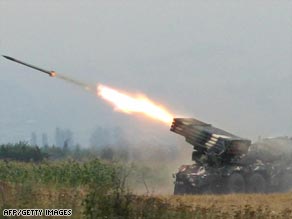 AP/Getty Images Georgian MLRS firing on Ossetian Positions
 AP Russian Armored Divisions Entering Georgia
(Possibly a Motor Rifle Brigade).
Confirmed Reports they are heading towards Tskhinvali
 Channel 1 New: Russian T-80 Tank with reactive armor
Main Battle Tank designed for larger conflicts
Analysis 11:52AM PT: Any conflict will end soon through either a cease-fire or a surrender. If the conflict escalates in the next 48 hours, Abkhazia(another breakaway region in Georgia), has vowed to open up a second front. Russia, with the support of these two regions, can overrun the country in a short period of time. There won't be much scrutiny on Russian operations because of the media coverage of the Olympics. However, it's more likely that the UN and/or the EU will broker a cease-fire agreement giving Russia de facto control over South Ossetia. It will be interesting to see how this conflict pans out. In reality this is a proxy conflict between Russian interests and NATO interests. We can see who has the upper hand by the result of this conflict. Russia has resources for a full invasion, and we will sonn see if they want to escalate these tensions.
Update 11:08AM PT: NATO and EU have urged a cease-fire, and reports of a open conflict are surfacing. Russian PM Vladimir Putin has been quoted saying "War has started". We will probably get the full information in 8-10 hours since it is night right now in that region. Russia is probably stepping up its aerial operations under the cover of night fall
Initial Report: There are reports of sporadic fighting between the Georgian military and Russian troops, in the breakaway province of South Ossetia. Violence has been mounting for weeks now culminating in this "invasion" by Russia. The Georgian press is reporting 150 Russian armored vehicles have entered Georgian territory, and also are reporting aerial bombardment by Russian war planes. Fighting does not seem to be widespread right now, and it is just focused along the border between Russia and South Ossetia right now. Moscow's response was that this incursion was in response for "ethnic cleansing" reports, and attacks on Russian peacekeepers. Eastern European stock markets took a major hit from this escalation of violence, and the Russian stock market fell 6.5%. Expect an increase in oil prices if this conflict escalates even more, since the Caucus is critical for Black Sea Oil exports. We will report on more news as it comes in.
Tuesday, August 5, 2008
Wind: Answer to Our Problems?
Yesterday, T. Boone Pickens was on Larry King Live to discuss his energy plan, which he claimed was the answer to all of our problems. One of his most interesting proposals was a "Wind Corridor" from Texas to the Canadian border. I decided to analyze the feasibility of such an investment and if this would really solve our energy needs.
The optimal way to capitalize on a wind corridor would be to build "wind farms", and interconnect these farms to some sort of a main distribution grid. This is easier said than done, since wind turbines have to be spread out over large areas of land to produce at their maximum capacity. There is something called a "wind park" effect that degrades a turbines output when large turbines are too close to each other. Large is probably an understatement 2000 large-diameter turbines will need 20,000 acres or more to operate at optimal efficiency, and to cause minimal impact to the local environment. We need to understand that these are not the regular we see on the side of the highway; these are super-sized turbines designed to produce 1MW-6MW of power each.
So this is how I see the "business" side such a plan working out:
My conclusion is that this plan will cost trillions of dollars, and billions more per year to maintain. With present technology, much of the generated power will be wasted. The details of this plan are good, but we are still years away from putting such a proposal into action. This plan would provide much needed high tech jobs and money to the heartland of the US. However, we still need to have a better understanding of efficient wind production, power transmission, and wind turbine placement.
The optimal way to capitalize on a wind corridor would be to build "wind farms", and interconnect these farms to some sort of a main distribution grid. This is easier said than done, since wind turbines have to be spread out over large areas of land to produce at their maximum capacity. There is something called a "wind park" effect that degrades a turbines output when large turbines are too close to each other. Large is probably an understatement 2000 large-diameter turbines will need 20,000 acres or more to operate at optimal efficiency, and to cause minimal impact to the local environment. We need to understand that these are not the regular we see on the side of the highway; these are super-sized turbines designed to produce 1MW-6MW of power each.
So this is how I see the "business" side such a plan working out:
- The company that develops this corridor would be some sort of a Government Sponsored Entity. They would go county by county and strike deals with the local governments for setting up wind farms. Counties would use either eminent domain, or paying annual fees for the use of private property. Anywhere that a building rights issue arise, the Federal Government would use their "override" powers to keep development going.
- State governments would provide the necessary support infrastructure for the wind farms, and determine intra-state power distribution.
- The Federal Government would create a central grid, that would sell the power to local utility companies, at rates agreed upon by the state governments. Utility companies would sell this power to their consumers, while phasing out old power plants.
- The state/federal government would provide tax incentives for Utility companies to use this power.
- This needs a full computerized national power grid, that would handle distribution. No presently available power grid can manage this much energy/ transmission.
- Tens of thousands of miles worth of new transmission lines will have to be erected and staffed.
- Transmission of those distances will have significant power loss, and it is not practical to distribute this power to the west coast with current technology.
- State wide power consumption is not even, and urban centers require significantly more power than rural. Additional transmission is needed from state distribution centers to urban areas.
- Wind power production is uneven, and the technology to store and release energy at an even rate is still years away.
- It is much more efficient to use wind power locally, rather than connecting distant wind farms to a central grid.
My conclusion is that this plan will cost trillions of dollars, and billions more per year to maintain. With present technology, much of the generated power will be wasted. The details of this plan are good, but we are still years away from putting such a proposal into action. This plan would provide much needed high tech jobs and money to the heartland of the US. However, we still need to have a better understanding of efficient wind production, power transmission, and wind turbine placement.
Sunday, August 3, 2008
Tropical Storm Edouard
Final Update 9:23PM PT: Asian markets are all down, expect US markets to react accordingly. Be careful because we have seen this pattern before, pre-market fall on overnight news, and then a rally following better news throughout the day.
Update 6:41PM PT: Confirmation that the regions affected by the storm are oil producing areas. Because of the storm's weakness, there should be inconsequential damage to oil supply. Expect prices to surge tomorrow morning and set up positions as news comes in. Typically, and foreseen disruptions are factored into the price until better news comes in. It will be a savvy strategy to predict the price peak and set up short positions on USO Monday afternoon.
Update 3.55PM PT: Storm could hit Texas coast in 36 hours, if you live in these areas start taking appropriate cautions.
Developing Story 3:41PM PT: A tropical storm has just developed of the coast of Louisiana, and initial models suggest that it will move west. It looks like this storm will pass over some key oil facilities in the Gulf Coast, unsure whether it is strong enough to cause supply disruptions. Expect crude oil futures to jump as the hurricane strengthens, but we will monitor the situation closely. Any change of path or weakening of the storm will have an opposite effect on the price of oil. In any case you can expect a surge in prices tomorrow morning as people get the news and the full picture of this storm. Those prices will hold or drop as new information. comes in. USO, an ETF backed by oil futures, will have a lot of action tomorrow with people establishing both long and short positions because of the storm. Remember commodity prices are very volatile and use caution when getting involved with this sort of speculation. If prices do jump significantly expect the market as a whole to react negatively.
Update 6:41PM PT: Confirmation that the regions affected by the storm are oil producing areas. Because of the storm's weakness, there should be inconsequential damage to oil supply. Expect prices to surge tomorrow morning and set up positions as news comes in. Typically, and foreseen disruptions are factored into the price until better news comes in. It will be a savvy strategy to predict the price peak and set up short positions on USO Monday afternoon.
Update 3.55PM PT: Storm could hit Texas coast in 36 hours, if you live in these areas start taking appropriate cautions.
Developing Story 3:41PM PT: A tropical storm has just developed of the coast of Louisiana, and initial models suggest that it will move west. It looks like this storm will pass over some key oil facilities in the Gulf Coast, unsure whether it is strong enough to cause supply disruptions. Expect crude oil futures to jump as the hurricane strengthens, but we will monitor the situation closely. Any change of path or weakening of the storm will have an opposite effect on the price of oil. In any case you can expect a surge in prices tomorrow morning as people get the news and the full picture of this storm. Those prices will hold or drop as new information. comes in. USO, an ETF backed by oil futures, will have a lot of action tomorrow with people establishing both long and short positions because of the storm. Remember commodity prices are very volatile and use caution when getting involved with this sort of speculation. If prices do jump significantly expect the market as a whole to react negatively.

Friday, August 1, 2008
Pakistan on verge of financial crisis

If you thought the news from this region of the world could get any worse, think again. News has surfaced about plummeting foreign exchange reserves in Pakistan. Just last week alone the reserves dropped 2.5%. Most investors want to avoid the political instability and the weak coalition that is holding Pakistan together. Pakistan's reserves now total approximately $10.5B, and are steadily dropping every day. Saudi Arabia has deferred Pakistan's energy payments, and is willing to renegotiate payments at a later date. The government's current account deficit as also fueled already high inflation and the there is a danger this can spiral out of control. This looks like the classic early 90's economic crisis formula: slow down+ no reserves + deficit = hyper inflation.
More importantly we must fear the consequences that will come out of such a financial crisis. If the current government looses its control, we may not like its replacement. The last thing the world needs is a rouge nation with nuclear weapons, no money, and an angry population. This is the doomsday scenario, but there are many more intermediate scenarios that will hurt us just as badly. Since the Pakistani Government's main expenditure is on military and security forces, they are likely to cut back on these costs. They have approximately 300,000 troops on the Indian LOC in "Azad" Kashmir, and they are not likely to cut these forces due to the threat of an Indian invasion. They will cut their security forces in FATA(Federaly administerd Tribal Areas ) and NWFP(Northwest Fronteir Provences). These areas are isolated from the rest of Pakistan as is so a withdrawal of troops would further this isolation. These areas are dominated by Pashtun ethinicity tribes, unlikes the Punjabis or the Sindhis in the east. Pashtuns are by nature more fundementalist, and have more sympathy for extremist elements. This will give safe havens to organizations like Al Queida, the Taliban, LeT, etc. Also, when the locals in the tribal regions have no security or economic livelihood they turn to regional warlords for money and safety. These warlords often engage in arms, human, or drug trafficing to finance their operations.
 Looking at this data it is obvious that Pakistan has been propped up by US military aid. If this aid is to drop or cease for any reason, the country will be on the verge of ruin. Unfortunaley most of this aid has been wasted on strategic weapons to standoff with India. Much of that money was not used to fortify government control in FATA, Baluchistan, and NWFP. To make matters worse, this week the CIA has released information that highlights how the ISI (Pakistani Military Intelligence) is heavily comprimised by extremists. Any coup or instability is likely to originate from sympathetic ISI or Military officers. It has long been suspected that the ISI is behind many terrorism incidents in South Asia. This CIA report basicaly confirms much of the West's suspicions. The local population will willingly support a violent coup, if they are in a desperate position. Anti-inflation measures will drive up unemployment, and the population is feeling a sever pinch. Any event that will jepordize the political stability in Pakistan will lead to another round of foreign divestment and further pressure exhange reserves.
These collapses happen very fast, and countries can fall apart in less than 48 hours. Fortunately they have allies in Saudi Arabia and U.A.E that will be willing to finance their debts. Unfortunately, solving this crisis is not that easy, extra finances just postpones the problem rather than fixing it. Much of Pakistan is still rural(even though the land is not neccessarily suited for agriculture), and it will be very difficult to produce economic growth in that area. Much of the population are agianst modernization and westernization since they feel they will degrade their Islamic values. If you thought that the Pakistan saga is over once Bush leaves office and the military aid ends, think again.
This news adds a new dimension to the Islamic Extremist problems that plauges the region. If this nuclear state was to fail, what happens next? And will we be willing to deal with whatever is in control in Pakistan?
Subscribe to:
Comments (Atom)